




Is the Human Right to be Protected from Climate Change Enough? Decolonial Reflections on an Indian Renewable Energy Case

A global surge in litigation targeting governments is in the air after the International Court of Justice ruled that states have obligations under international law to act against climate change. While surely a huge step forward, we must pause to look at a critical player in the process, courts themselves.
We must ask: can courts shape societal transformations towards climate justice for the most vulnerable simply by recognising protection from climate change as a human right?
One decision by the Indian Supreme Court dealing with the impacts of large-scale renewable energy projects gives us a clue:
legal recognition such as the above needs to be accompanied by a transformation of how we govern ourselves and societal goals around energy use and quality of life.
Courts can play a powerful role in guiding or hindering that process by selecting whose visions they endorse about technologies like renewable energy and how they should be governed.
Context: An Indian Supreme Court Case on the Ecological Impacts of Renewable Energy Projects
In March 2024, in a judgment in the case MK Ranjitsinh v Union of India, the Indian Supreme Court affirmed that the right to be protected from the harms of climate change is part of the fundamental right to life under the Indian constitution.
It also did something remarkable by acknowledging the adverse ecological impacts of renewable energy projects and trying to mitigate them.
This was a departure from most Indian courts’ failure to lay down checks on the expansion of large-scale renewable energy projects, even as many Indian litigants have been approaching courts to address impacts like the loss of common pool resources (e.g. grazing, sacred groves, access roads), loss or pollution of drinking water sources and wildlife habitats, tree felling, and the like.
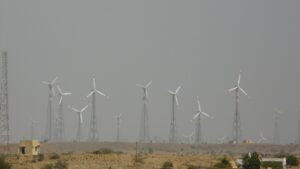
The judgment is crucial in a context where the central government is diluting environmental and social safeguards against potential negative impacts in a bid to accelerate renewable energy, to create gigantic projects: India has some of the largest solar PV parks and wind farms in the world, such as the 2.2 GW Bhadla Solar Park in Rajasthan, spanning 14,000 acres (56 sq. km).
But more than a legal analysis of the reasoning or findings of the court, it is important to look at which stories the court told about renewable energy through its judgment, which it left out, and whose.
Grassroots Movements around the Environmental and Social Impacts of Solar and Wind Projects in Rajasthan, India
The grasslands of Gujarat and Rajasthan in western India have long been home to sensitive ecosystems with rich biodiversity. Areas with water bodies have been especially critical to the lives and cultures of local communities in the predominantly dry climate.
Large swathes of such grasslands were often designated as sacred groves called orans, left untouched by local villagers for centuries. The Bhadariya Oran, for instance, spans roughly 20,000 acres.

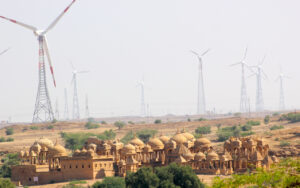
But over the last few years, these sunny and windy areas have attracted the attention of solar and wind energy companies and governments.
This increased industrial activity, often in the form of large-scale solar energy parks or wind farms, has been challenged by local conservationists and communities for potential ecological and cultural impacts.
Radheshyam Bishnoi, a young environmentalist who passed away in a road accident earlier this year while responding to a wildlife poaching alert, was one such person.
Radheshyam hailed from the Bishnoi community, a traditional sect renowned across India for their centuries-old strong wildlife protection ethos and lifestyle. He campaigned tirelessly to protect the orans and several of its endangered species from threats like poaching, and led many community conservation projects.
One of his focus areas was protecting the Great Indian Bustard (GIB), a large, endangered bird with the orans as one of its last remaining habitats. He especially advocated against the power lines that were coming up across the orans, which are essential to deliver power generated from solar and wind energy projects to different parts of the country.
This was because the birds were dying from electrocution when they flew into power lines, collisions they could not avoid because of their poor frontal vision and heavy weight.
Radheshyam was a central figure in the grassroots movement to advocate for the power lines to be made underground to protect the birds, and to limit the expansion of renewable energy projects in and around the orans.
Another key figure was MK Ranjitsinh, a prominent Indian conservationist who was among many petitioners and groups who approached different local and national courts related to these issues.
Citizens’ Legal Challenge to Protect Biodiversity and the Court’s First Ruling
It was in a petition filed by MK Ranjitsinh alongside three other local and national wildlife activists that the Supreme Court in 2022 finally took steps to protect the Great Indian Bustard (referred to as GIB-1 below).
The petitioners wanted the Court to look at different ways to protect the bird, including installing bird divertors for some lines, and generally banning overhead power lines and further windmills and solar infrastructure in what wildlife scientists had identified as priority and potential habitats.
The Court in GIB-1 dealt only with some of these aspects, creating an expert committee to look at the feasibility of putting the cables underground to protect the birds’ habitat. All low-tension power lines would have to be converted to underground, and high-tension power lines too, wherever feasible. This had to be done within a year. Where undergrounding was unfeasible, bird divertors would have to be installed.
But the central ministries of environment, power and renewable energy were not satisfied and approached the court to modify this order.
They argued that the Ministry of Renewable Energy had not been heard while passing the order in GIB-1, and that putting high voltage power lines underground was inherently technologically unfeasible and would adversely impact the energy transition and India’s global climate commitments, and thus ultimately the environment.
These arguments were addressed by the Supreme Court in a subsequent judgment (referred to as GIB-2 below, see footnote 1). Following the judicial system of hearing cases in “benches”, the second decision was given by a different set of judges than the first.
The Court’s Second Ruling: Gaps in Representing Local Communities while Aligning with the Global Push for Renewable Energy
The Court created a new expert committee to look at, among other things, the feasibility of overhead and underground power lines, and to find other ways to balance protecting the GIB with an arrangement of power lines that facilitated India’s climate commitments (pages 43-48). The Court also asked the Union Government to take measures for GIB conservation (pages 48-50).
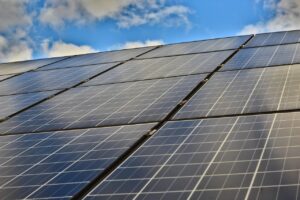
To reach this conclusion, the Court focussed on showing how solar energy aligned with India’s “broader sustainable development objectives” and would help achieve “sustainable growth” (pages 26, 39).
These hopes were mirrored by fears about the non-adoption of renewable energy, which the Court equated with implementing the directions in GIB-1.
Overlooking the distinction made between high-voltage and low-voltage lines in the earlier judgment, the court in GIB-2 believed that implementing the earlier order in the GIB habitat would effectively be a ban on solar power distribution, since this area, which it estimated to be about 99,000 acres, contained the “lion’s share of the potential areas from which wind and solar energy may be harnessed” (page 35).
The Court focussed on highlighting benefits for Indian energy security, in addition to considering environmental and climate impacts, and socio-economic impacts.
What kind of impacts were considered and omitted by the Court, and were there gaps in how marginalised communities were represented?
Social and Environmental Impacts Considered and Ommitted by the Court
The Court spoke several times about the impacts of climate change on vulnerable communities and the broader environment, and the benefits to be gained from renewable energy.
One example was about benefits to rural women from a reduced reliance on indoor cooking and firewood collection.
Others included combating air pollution by reducing the burning of coal, or protecting the homes and traditional sustenance activities for forest dwellers or tribal and indigenous communities from the vagaries of climate change.
Of course, the court assumed that the energy from these large renewable energy projects would actually reach the most vulnerable groups.
Even the data on many of the benefits that it cited was, by its own admission, about distributed (small-scale, local) solar projects, not centralised ones (page 26) which would need power transmission lines over long distances.
But more importantly, the court glossed over the crucial concern of governments pushing ahead with renewable energy by diluting environmental and social safeguards.
In this, the court also ignored the potential impacts of this oversight on vulnerable groups like traditional or indigenous agro-pastoral communities, whose access to grasslands used for grazing, fodder, or medicine collection, sacred groves, or places with other socio-economic and cultural value could be closed off or impacted due to large-scale solar projects, as mentioned above (see footnote 2).
Sidelining Community Perspectives and Contestation around Renewable Energy, Conservation and Culture
The way marginalised communities were represented in the judgment, and who got to speak and prove their arguments also left much to be desired. They were visible, and used by the court prominently to make points, but their direct voices were unheard.
For example, the Court does not refer to any arguments or perspectives raised by local activists, even though local activists were also petitioners in the case alongside MK Ranjitsinh: one example is Peera Ram Bishnoi, a local mechanic-turned conservationist from the same wildlife-respecting cultural sect as Radheshyam Bishnoi.
But while the Court sometimes looked at varied sources of law and on-ground research to substantiate its points about the need to adopt renewable energy, it did not have a word to spare for the history of contestation around renewable energy projects and conservation in the area, through the spirited struggles of local activists like Radheshyam and Peera Ram.
This is even more jarring when we reflect on the examples the Court does cite. To make a point about the unequal impacts of climate change and why inaction around the energy transition could violate the fundamental right to equality, the Court talks about indigenous people with a traditional way of life in the Andaman and Nicobar Islands, part of an archipelago about 750 miles or 1200 km from the nearest point on the Indian mainland.
The Court gives the reason that these communities may be impacted more by rising sea levels due to unabated climate change, and experience a “permanent loss of their unique culture” (page 21).
And yet, as of today, these same indigenous communities of the Andaman and Nicobar islands are most at danger with a model of development that creates ‘jobs’, brings ‘economic opportunity’, and is fuelled by ‘clean energy’: because of a major infrastructure project proposed by the central government that will impact lives and livelihoods and the region’s fragile ecological balance, and ultimately also its resilience to climate change.
Some of the tribal governing bodies are disputing that they consented to the project, and even international genocide scholars have called it a potential genocide of the vulnerable Shompen tribe, a group so far mostly uncontacted by outsiders.
Can this project be deemed ‘clean’ and ‘green’ just because it would be fuelled by solar and wind power?
Reliance on Scientific Experts in Decision-making
Ultimately, the Court in the GIB-2 decision favours an expert-led approach, where the experts are selected in a rather intransparent way by the Court itself. This is clear from the way that the Court asks the parties’ counsel to suggest suitable experts, but goes on to name the final members after simply stating that all suggestions were evaluated (page 43), and in the process gives no reasons as to why the committee formed in GIB-1 was disbanded in the first place.
These scientists, formally trained in the western paradigm, are given tasks ranging from assessing the feasibility of undergrounding power cables, identifying layout alternatives and conservation measures, and undertaking GIB conservation monitoring and research in the area (pages 45-47).
In the process, they are asked only to ‘engage’ with stakeholders like “government agencies, environmental organizations, wildlife biologists, local communities, and energy industry representatives” (page 45). The ‘experts’ thus become the sieve through which the views of those directly impacted by their decisions pass.
The Decolonial Perspective on the Case: How to Achieve Climate Justice?
Recognising people’s right to be protected against climate change can play a transformative role in accelerating climate action. But preventing climate change cannot be reduced to achieving an energy transition, as has been repeatedly pointed out in discussions on decolonising climate action approaches.
We need instead a transformation of how we govern ourselves and the goals we aspire for as a society by challenging the developmental paradigms that are inextricably tied to colonialism and exploitation.
For all its emphasis on protecting vulnerable people, the court in GIB-2 ultimately endorses a model of development where it is barely necessary to ask them if they face any impacts from energy projects: despite being the supposed ultimate beneficiaries of the jobs, energy and better standard of living that the projects promise.
Far from being a transformation, this could very well be a continuation of the status quo, where decisions about people are made without them, and they are left to wait for the trickle down of promised benefits which they may or may not aspire to.
This case reminds us that developments on the international level, such as the ICJ ruling affirming states’ obligations under international law to address climate change, might not be sufficient to ensure decoloniality in climate action.
The same goes for historical colonizers and GHG emitters offering former colonised countries and historically low emitters technology and money to reduce emissions and adapt to climate change—which in itself could also reinforce colonial logics: the impacts of carbon markets on indigenous peoples’ rights being one example.
At the end of the day, what we also need is all countries introspecting about the forms of governance they have and the relationship they have with the environment and with their people, especially with the most sidelined and exploited communities.
It’s about how we imagine development and progress and well-being and sustainability, and the role that technology plays in advancing these goals.
This is important when we talk about domestic adjudication too, because courts will continue to play an important role in determining whether or not ‘sustainability’ and ‘renewable energy’ become buzzwords to gloss over the social and environmental impacts of non-fossil fuel technologies.
Ultimately, those of us seeking courts’ help to drive transformations for a sustainable and equitable future must guide and push them to prevent this by adopting a decolonial approach, where, above all, the voices of those most impacted are front and center in decision-making.
About the Author
Malvika Kaushik is an Indian lawyer and policy researcher with a background in environmental justice and human rights litigation. She has previously worked in India as Assistant Coordinator (Legal) at the NGO Environment Support Group, where she supported Indigenous Peoples and Local Communities in undertaking litigation, policy advocacy and educational initiatives. She was also formerly a legal researcher at the Supreme Court and holds an MSc in Environmental Governance from the University of Freiburg, Germany.
This article is partially based on her research for her master’s thesis, where she examined if and how Indian renewable energy adjudication reflects and endorses dominant and alternate worldviews and sources of knowledge, using the sociotechnical imaginaries framework.
Footnotes:
(1) M.K. Ranjitsinh v. Union of India, 2024 INSC 280. https://climatecasechart.com/wp-content/uploads/non-us-case-documents/2024/20240321_67806_judgment.pdf
(2) Chouhan, P., Mrinali, Sambhav, K., Barrio, F.. (2024). The Hidden Cost of Green Growth (Mehak Mahajan, Ed.). https://cdn.prod.website-files.com/5d70c9269b8d7bd25d8b1696/67bc78023e2febfd7ae9ae31_LCW_RE_FullBook%20(2).pdf
Banner image credit:
Image credit: राजू जांगिड़
Image under license Creative Commons and CC BY-SA 4.0
Link: https://commons.wikimedia.org/wiki/File:Anna_Rajasthani_grass.jpg
Do you agree? What is your opinion of this article?